The digital landscape is undergoing a seismic shift as artificial intelligence transforms how humans discover information online. Traditional search engine optimization focused on ranking in a list of blue links, but the rise of generative AI has introduced a new era of discovery. AI SEO is the strategic process of ensuring your content is not only discoverable but also extractable and trusted by AI-powered search experiences. If your brand is not optimized for these intelligent systems, you risk becoming invisible to a growing population of users who prefer conversational answers over manual browsing.
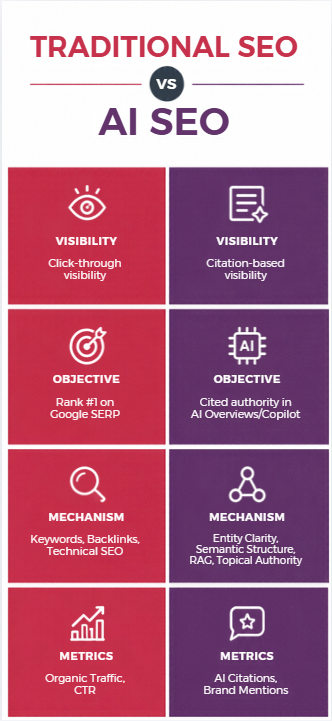
Understanding AI SEO requires a fundamental shift in how we perceive visibility on the web. In the past, success meant appearing on the first page of Google to drive a click to your website. Today, success means being the primary source that an AI assistant cites when it summarizes an answer for a user. This transition from "click-through" to "citation-based" visibility is the core of the AI SEO discipline. By aligning your content with the way large language models interpret data, you can secure a dominant position in the new age of generative search.
Defining the Core of AI SEO
AI SEO is more than just using AI tools to write content faster. It is a comprehensive approach to optimization that targets the retrieval mechanisms of generative engines like Google AI Overviews, Bing Copilot, and Perplexity. These systems do not simply look for keywords; they analyze entities, relationships, and semantic meaning to construct a cohesive answer. AI SEO ensures that your brand is recognized as a trusted entity that provides the most accurate and relevant data for a specific query.
This discipline brings together several emerging concepts, including Generative Engine Optimization (GEO) and Answer Engine Optimization (AEO). While some marketers treat these as separate strategies, they are actually different facets of the same evolution. GEO focuses on how generative models synthesize information, while AEO targets the direct answers provided by voice and chat assistants. AI SEO serves as the umbrella strategy that unifies these approaches to ensure holistic visibility across all AI-influenced surfaces.
Traditional SEO remains the foundation, but AI SEO builds a sophisticated layer on top of it. You still need a fast website and high-quality backlinks, but you now also need semantic clarity. If an AI cannot easily extract a specific fact from your page, it will simply use a competitor's page that is better structured. The goal is to move from being a "ranked page" to becoming a "trusted knowledge source" for the AI.
The Mechanics of AI Search and Grounding
To optimize for AI, you must first understand how these systems actually work. Most modern AI assistants use a process called Retrieval Augmented Generation, often referred to as RAG. When a user asks a complex question, the AI does not rely solely on its pre-trained data, which might be outdated. Instead, it performs a real-time web search to find current, authoritative sources to "ground" its response in reality.
Grounding is the mechanism that prevents AI hallucinations by forcing the model to reference external evidence. The AI identifies the most relevant pages, extracts the key passages, and synthesizes them into a conversational response. If your content is the one retrieved during this grounding phase, the AI will use your data and often provide a citation link to your site. This makes the grounding process the most critical window of opportunity for modern digital marketers.
This process relies heavily on the AI's ability to parse your content quickly and accurately. If your information is buried under complex JavaScript or written in vague language, the AI may struggle to extract the necessary facts. By providing clear, structured, and direct answers, you increase the probability that your site will be chosen as a grounding source. This is why the technical and semantic structure of your pages is now just as important as the content itself.
The Critical Importance of Entity Clarity
AI systems do not view the web as a collection of keywords, but as a web of entities. An entity can be a person, a brand, a product, or a specific concept. AI SEO prioritizes entity clarity, which means ensuring that the AI knows exactly what your brand is and how it relates to other known entities in your industry. If your brand identity is ambiguous, the AI may misclassify your expertise or ignore you entirely.
Achieving entity clarity requires consistency across all digital touchpoints. This means using the same naming conventions, clear definitions, and structured data across your website, social profiles, and third-party mentions. When an AI sees your brand mentioned consistently alongside specific high-value topics, it builds a "knowledge graph" of your authority. This associations-based trust is what allows an AI to confidently recommend your product over a generic alternative.
You can strengthen your entity profile by using Schema markup to explicitly tell the AI who you are. Structured data provides a machine-readable layer that defines your organization, your products, and your reviews in a format the AI doesn't have to guess. By removing the guesswork, you make it easier for the AI to categorize your brand as a leader in your niche. Clear entity relationships are the bedrock of trust in a generative search environment.
Structuring Content for Maximum Extractability
Extractability is the ease with which an AI can pull a specific piece of information from your page to use in a summary. Many websites write for humans using narrative styles that are engaging but difficult for machines to parse. AI SEO requires a balance where the content remains human-readable but is structured for rapid AI extraction. This is achieved by using clear headings and direct, factual statements.
One of the most effective ways to improve extractability is to lead with the answer. Instead of building up to a conclusion over several paragraphs, state the primary fact or answer immediately under a sub-heading. This allows the AI to identify the "answer passage" instantly during the grounding phase. Following the answer with supporting context and examples ensures that both the AI and the human reader get the depth they need.
Avoiding vague language is also essential for high extractability. Terms like "industry-leading" or "innovative" provide no factual value to an AI and are often ignored. Instead, use measurable facts, such as "reducing energy costs by 30%" or "serving 50,000 clients globally." Specificity provides the "hard data" that AI models crave when they are synthesizing a factual response for a user.
The Shift Toward Topical Authority and Depth
In the era of AI SEO, keyword stuffing is not only dead but actively harmful. AI models are designed to detect "thin content" that exists only to rank for a specific term. To be visible in AI search, you must demonstrate genuine topical authority. This means covering a subject in its entirety, exploring the nuances, and providing deep, expert insights that a general AI model cannot generate on its own.
Topical authority is built by creating content clusters that address every possible question a user might have about a topic. Instead of writing one giant guide, create a series of interconnected articles that dive deep into specific sub-topics. This network of information signals to the AI that your site is a comprehensive resource. When the AI sees that you have expert-level coverage of an entire ecosystem, it is more likely to cite you as a primary authority.
Genuine expertise is also signaled through the inclusion of original research, case studies, and unique data. AI models are trained on existing web data, so they can easily replicate common knowledge. However, they cannot replicate your unique experiences or the proprietary data your company has collected. By publishing original findings, you provide "new information" to the AI, making your content an indispensable source for grounding.
Technical Foundations for AI Discovery
While the focus of AI SEO is often on content, the technical foundation remains the gatekeeper of visibility. If an AI crawler cannot access your site or if your pages take too long to load, you will not be included in the retrieval phase. Ensuring that your robots.txt file allows AI crawlers is a basic but critical step. Blocking these crawlers in an attempt to protect content often results in complete invisibility in AI answers.
Internal linking also plays a massive role in how AI perceives the importance of your pages. A strong internal linking structure helps the AI understand the hierarchy of your information and the relationships between different topics. By strategically linking your deep-dive articles back to your main pillar pages, you guide the AI toward your most authoritative content. This creates a map of knowledge that the AI can follow to validate your expertise.
Furthermore, the way you handle page rendering can impact AI retrieval. Heavy reliance on client-side JavaScript can sometimes hide content from simpler AI crawlers. Ensuring that your most important factual data is available in the HTML source code guarantees that every AI system can see it. A technically clean site is a site that is easy for an AI to trust and reference.
Writing for Intent and Conversational Queries
The way people search is changing from short keywords to long, conversational questions. Instead of searching for "best coffee machine," users are now asking "What is the best beginner coffee machine for a small apartment with a low budget?" AI SEO requires you to optimize for this intent-based searching. Your content must mirror the natural language and the specific constraints that users bring to their conversations with AI.
To capture this traffic, you should incorporate a "Question and Answer" approach within your articles. By explicitly stating the common questions your audience asks and providing direct, concise answers, you align your content with the conversational nature of AI. This makes your page a perfect match for the "prompt" the user gives to the AI assistant. When the query and the content match perfectly in intent, the likelihood of a citation increases.
It is also important to use synonyms and related terms to reinforce the meaning of your content. AI models use semantic vectors to understand that "noise level," "decibel rating," and "quietness" all refer to the same concept. By using a variety of related terms, you help the AI connect your content to a broader range of user queries. This semantic richness makes your content more resilient to the variations in how different people phrase their questions.
The Role of AI Tools in the SEO Workflow
Paradoxically, the best way to implement AI SEO is by using AI tools. AI can handle the massive amount of data analysis required to identify semantic gaps in your content. Tools can analyze thousands of search results in seconds to determine which factual elements are common among the top-cited sources. This allows you to optimize your content based on evidence rather than intuition.
AI can also assist in the creation of detailed content briefs that ensure topical depth. By using AI to map out all the sub-topics and questions related to a primary keyword, you can ensure that your human writers cover every necessary angle. This synergy between AI analysis and human creativity allows for the production of high-authority content at a scale that was previously impossible.
However, the danger lies in over-reliance on AI for the actual writing. If you use AI to generate the final text without human oversight, you risk producing "average" content that looks like everything else on the web. AI-generated text often lacks the unique insights, emotional resonance, and real-world experience that truly signal authority to both humans and AI models. Use AI for the blueprint, but use humans for the building.
Avoiding the Pitfalls of AI-Driven Content
The ease of AI content generation has led to a flood of mediocre articles across the web. Many brands have made the mistake of automating their entire blog, only to find their rankings plummeting. AI models are increasingly becoming better at detecting AI-generated patterns, and search engines are rewarding content that shows "Experience, Expertise, Authoritativeness, and Trustworthiness" (E-E-A-T).
One major pitfall is the lack of factual verification. AI models can hallucinate facts or present outdated information as current. If you publish AI-generated errors, you destroy your brand's trust with both the user and the AI search engine. A rigorous human editing process is mandatory to ensure that every claim is verified and every statistic is accurate. Accuracy is the primary currency of trust in AI SEO.
Another mistake is ignoring the user experience in favor of machine optimization. While it is important to make content extractable for AI, the final reader is still a human. If your page is a dry list of facts without any narrative flow or visual appeal, users will bounce immediately. High bounce rates signal to search engines that your content is not helpful, which can eventually lead to a decrease in your AI visibility.
The Future of Digital Discovery and Brand Presence
As AI continues to evolve, we will move toward a world of "hyper-personalized" search. AI assistants will not only know the general answer to a query but will tailor that answer based on the user's history, preferences, and current context. In this future, the brands that survive will be those that have a strong, clear, and trusted entity profile. Your brand will no longer be a destination you drive traffic to, but a trusted advisor that the AI integrates into the user's life.
We can expect a shift toward multimodal discovery, where AI synthesizes information from text, images, and video into a single response. AI SEO will expand to include the optimization of these other media types to ensure they are also extractable and citable. The brands that embrace this holistic approach to visibility will dominate the digital landscape. The focus will move entirely away from "gaming the algorithm" and toward providing genuine, verifiable value.
Ultimately, AI SEO is about returning to the roots of the web: providing the best possible answer to the user's question. The technology has changed, and the interfaces have evolved, but the fundamental goal remains the same. By focusing on clarity, authority, and trust, you ensure that your brand remains relevant regardless of how the technology changes. The future belongs to the sources that the AI can trust.
Conclusion
AI SEO represents a fundamental shift in the digital marketing paradigm, moving the goalpost from organic rankings to AI citations. By focusing on entity clarity, semantic structure, and genuine topical authority, brands can ensure they remain visible in an era of conversational search. The integration of RAG and grounding means that high-quality, factual, and well-structured content is more valuable than ever. While AI tools can accelerate the process, human expertise remains the essential ingredient for creating truly authoritative content. Those who adapt to these new rules of discovery will not only maintain their visibility but will build a deeper, more trusted relationship with their audience.
Summary
AI SEO is the strategic evolution of search optimization designed to make content discoverable and citable by generative AI systems like Google AI Overviews and Perplexity. Unlike traditional SEO, which focuses on ranking in a list of links, AI SEO emphasizes entity clarity, semantic structure, and the "grounding" process that AI models use to verify facts. By creating deep, expert-led content that is easy for machines to extract and trust, brands can secure visibility in conversational search interfaces. Success in this new era requires a blend of technical optimization, rigorous fact-checking, and a shift toward intent-based, conversational content that provides genuine value to the end user.